Explore Wall-Mount Dressing Mirrors: An Informative Guide to Designs, Types, and Details
Wall-mount dressing mirrors are reflective surfaces designed to be fixed securely to a wall rather than simply placed on the floor or furniture. They are commonly used in bedrooms, dressing areas, bathrooms, entryways, and other interior spaces where both visibility and room appearance matter.
A wall mounted dressing mirror can range from a simple rectangular glass panel to a large full length wall mirror with a decorative frame. Some designs are frameless and minimal, while others use wood, metal, plastic, or composite frames to create a particular visual character.
The basic purpose is practical: a mirror allows people to check clothing, appearance, posture, or grooming. At the same time, a well-positioned wall mirror can influence how a room feels by reflecting light, architectural features, and surrounding furnishings.
Wall mirrors are available in several shapes and orientations. Rectangular and vertical mirrors are particularly suitable for dressing because they can show more of the body, while round and oval designs are often selected for decorative applications.
Why Wall-Mount Dressing Mirrors Matter
The importance of dressing mirrors goes beyond appearance. In smaller rooms, a carefully positioned mirror can create a stronger sense of openness by reflecting part of the surrounding space. It can also help distribute natural or artificial light when positioned appropriately.
A full-length wall mirror is especially useful in bedrooms and dressing areas because it provides a wider view than smaller vanity mirrors. A bathroom wall mirror, by comparison, is usually positioned above a basin and is intended primarily for grooming and personal-care activities.
Wall-mounted designs can also help organize floor space. Unlike a leaning wall mirror, a fixed mirror does not require a large floor footprint. This can be useful in compact bedrooms, apartments, hallways, and narrow dressing areas.
The choice also affects interior appearance. Modern wall mirror styles often use clean edges and simple frames, while traditional wall mirror designs may feature decorative borders, carved details, or classic finishes.
Common Types of Wall-Mount Dressing Mirrors
Different mirror types serve different purposes. The following table provides a simple comparison.
| Mirror Type | Typical Shape | Common Location | Main Characteristic |
|---|---|---|---|
| Full-length wall mirror | Tall rectangle | Bedroom, dressing area | Provides broad body view |
| Framed wall mirror | Rectangle, oval, round | Bedroom, hallway | Adds a defined border |
| Frameless wall mirror | Various | Bathroom, modern interiors | Minimal appearance |
| Round wall mirror | Circular | Bathroom, bedroom, entryway | Soft visual form |
| Oval wall mirror | Oval | Bedroom, bathroom | Combines height with softer edges |
| Mounted vanity mirror | Small to medium | Bathroom, dressing table | Focused grooming view |
| Decorative wall mirror | Various | Living room, hallway | Emphasizes visual design |
| Large wall mirror | Large rectangle or custom | Bedroom, studio, commercial interiors | Creates a strong reflective surface |
A full-length dressing mirror is generally selected when the user needs to see most or all of an outfit. A mounted vanity mirror is more appropriate for close-up grooming.
A frameless wall mirror can blend into contemporary interiors, whereas a framed wall mirror can become a distinct decorative feature.
Shapes and Orientations
The shape of a wall mirror influences both its function and visual effect.
Rectangular wall mirrors are versatile and commonly used for full-length or bathroom applications. Their straight edges work well with furniture, cabinets, doors, and architectural lines.
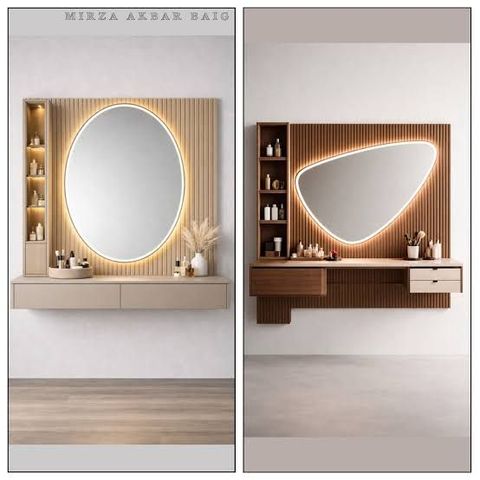
Round wall mirrors introduce softer geometry. They are frequently used above bathroom basins, dressing consoles, and entryway furniture.
Oval wall mirrors combine the vertical presence of a rectangular design with curved edges. They can work particularly well where a softer decorative appearance is preferred.
Orientation is also important. A vertical wall mirror is generally useful for dressing because it provides greater height. A horizontal wall mirror can work well above consoles, sideboards, or bathroom counters.
A mirror should therefore be selected according to both the available wall dimensions and its intended purpose.
Materials Used in Wall Mirrors
The main reflective surface is generally glass with a reflective backing, while the surrounding structure may use several materials.
Common frame materials include:
Solid or engineered wood
Metal
Aluminum
Plastic or polymer materials
Composite boards
Decorative laminates
Glass quality is particularly important. The Bureau of Indian Standards lists IS 3438:2023 for silvered glass mirrors for general purposes, while IS 2553 (Part 1):2018 covers safety glass for architectural, building, and general uses.
For areas where accidental impact is a concern, appropriate safety-glass specifications should be considered rather than selecting a mirror only for its appearance.
Choosing a Mirror for Different Rooms
The right mirror depends heavily on the room.
Bedroom wall mirror: A full-length dressing mirror is often useful near a wardrobe or dressing area. Vertical placement can make it easier to inspect clothing from head to toe.
Bathroom wall mirror: A bathroom mirror should be selected with humidity and moisture exposure in mind. Edge protection and suitable installation materials become especially important.
Entryway mirror: A medium-sized decorative wall mirror can provide a convenient final appearance check while also reflecting light and surrounding décor.
Living room mirror: Here, decorative function may be more important than full-body visibility. Large framed, round, oval, or artistic mirror designs can become focal elements.
Dressing area: A large wall mirror or full-length dressing mirror can provide a broader view and support wardrobe organization.
Wall Mirror Styles and Interior Design Trends
Wall mirror styles increasingly reflect broader interior-design preferences. In 2026, interior design coverage has emphasized personal expression, natural materials, layered textures, warmer palettes, and interiors that feel lived-in rather than overly staged.
These trends can influence mirror selection without requiring a particular style.
Modern interiors may use frameless mirrors, thin metal frames, simple rectangular shapes, or softly rounded designs. Traditional rooms may work better with detailed wooden or decorative frames.
Contemporary dressing mirrors can also incorporate unusual proportions, arched shapes, layered frames, or multiple mirror panels.
Another developing approach is to treat mirrors as decorative architectural elements rather than purely functional objects. For example, a group of smaller mirrors can form a visual composition, while a large mirror can become a prominent wall feature.
Practical Factors for Wall Mirror Installation
Wall mirror installation should be planned before the mirror is positioned. The wall needs to be capable of supporting the mirror and its mounting system.
Important considerations include:
Wall material and condition
Mirror dimensions and weight
Mounting hardware
Installation height
Distance from furniture
Moisture exposure
Edge protection
Clearance around the mirror
Accessibility for cleaning
A 2025 BIS draft document on mirror installation recommends mounting mirrors on clean, dry, stable surfaces and provides guidance on spacing behind larger mirror panels for ventilation. It also discusses appropriate adhesives, protective collars, washers, and moisture protection for bathroom environments. Because that document is identified as a draft, its recommendations should not be treated as a finalized mandatory code without checking the current applicable standard.
For large or heavy mirrors, professional assessment of the wall and fixing method can reduce the risk of detachment or glass damage.
Recent Developments and Design Trends
Recent interior trends show that mirrors are increasingly being considered as part of the overall visual composition of a room rather than isolated functional objects.
In January 2026, Architectural Digest India highlighted a broader interior movement toward personal expression, natural materials, warmer spaces, and more layered décor.
Reflective surfaces also continue to appear in contemporary bathroom and residential interiors. A 2026 example from New Delhi showed multiple mirrors used as an architectural and decorative feature, including a triptych arrangement with concealed lighting.
These developments suggest several practical directions for wall mirror design:
Softer round and oval shapes
Minimal frameless designs
Thin metal frames
Warm wood frames
Oversized mirrors
Multiple-mirror compositions
Mirrors combined with integrated lighting
Decorative designs that complement natural materials
The trend is not necessarily toward one universal mirror style. Instead, room-specific design and personal preference are becoming more important.
Laws, Standards, and Policies in India
In India, mirror selection and installation can intersect with building and material standards, especially when mirrors are incorporated into larger construction or interior projects.
The National Building Code of India 2016 (NBC 2016) provides a broad framework covering building materials, structural design, construction safety, glazing, building services, and other aspects of the built environment. BIS identifies Part 6, Section 8 as covering glass and glazing.
BIS also identifies IS 3438:2023 for silvered glass mirrors for general purposes. Safety glass is addressed through IS 2553 (Part 1):2018, which is included in India's compulsory certification framework for the relevant product category.
For ordinary household wall mirrors, there may not be one single rule governing every installation. Requirements can depend on the building type, location, glass specification, and project circumstances. Large architectural installations may require additional attention to structural and glazing requirements.
Helpful Tools and Resources
Several resources can make mirror planning easier.
Room measurement tools: A tape measure or digital measuring application can help record wall width, height, furniture dimensions, and available clearance.
Interior design software: Room-planning and 3D visualization applications can help users test different mirror shapes and positions before installation.
Wall and stud detection tools: Electronic wall scanners can help identify suitable fixing locations in certain wall constructions.
BIS standards resources: The Bureau of Indian Standards provides information about Indian Standards relating to glass, mirrors, and building construction.
Manufacturer installation documentation: Installation instructions can provide information about suitable mounting hardware, wall conditions, weight limits, and cleaning requirements for a particular mirror design.
A simple planning checklist can include:
Measure the wall
Identify the intended viewing area
Check wall construction
Estimate mirror weight
Select suitable hardware
Consider moisture exposure
Confirm installation height
Check surrounding furniture and doors
Frequently Asked Questions
What is the main difference between a wall-mounted mirror and a leaning mirror?
A wall-mounted mirror is secured to a wall, while a leaning mirror rests against the wall or another supporting surface. Wall mounting generally uses less floor space.
Is a full-length wall mirror suitable for a bedroom?
Yes. A full-length dressing mirror can provide a broad view of clothing and overall appearance. Its dimensions should match the available wall space and intended viewing distance.
Which shape is best for a bathroom wall mirror?
There is no single best shape. Rectangular mirrors are practical above many basins, while round and oval designs can create softer visual lines. The choice should also consider the basin, wall width, lighting, and moisture conditions.
Are frameless wall mirrors suitable for modern interiors?
Yes. Frameless designs can create a clean, minimal appearance and can work particularly well with contemporary interiors.
What should be considered before wall mirror installation?
Check the wall condition, mirror weight, fixing method, installation height, moisture exposure, and compatibility of mounting materials. Large mirrors may require additional installation planning.
Conclusion
Wall-mount dressing mirrors combine practical visibility with interior design functionality. From full-length wall mirrors in bedrooms to mounted vanity mirrors in bathrooms, different formats are designed for different spaces and purposes.
Shape, size, frame material, orientation, glass specification, and installation method all influence the final result. Rectangular and vertical mirrors often support dressing needs, while round, oval, decorative, and framed designs can contribute more strongly to room aesthetics.
Current interior trends also show greater interest in personal expression, natural materials, layered textures, and reflective features integrated into the overall design.
For Indian homes and interior projects, it is useful to consider applicable BIS standards and building requirements alongside appearance and room layout. A thoughtful dressing mirror guide should therefore cover not only style but also dimensions, materials, wall conditions, safety, and installation planning.

Related Post...
Explore Wall-Mount Dressing Mirrors: An Informative Guide to Designs, Types, and Details
Updated: November 23, 2026
Read More
Preschool Furniture Collections: An Informative Guide to Design, Use, and Detail
Updated: November 20, 2026
Read More
Explore Garden Storage Box Seats: Essential Facts, Materials, and Practical Idea
Updated: November 22, 2026
Read More