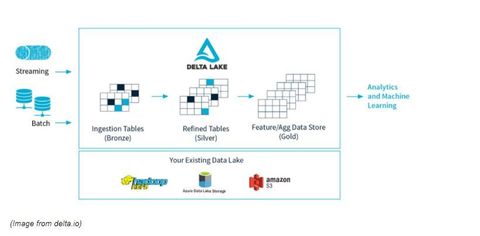
Traditional data lakes can store large volumes of information in relatively flexible formats. However, organizations may face challenges when multiple applications read and update data, processing pipelines fail, or different teams need consistent information for analysis.
Delta Lake addresses several of these challenges through a transaction log, schema controls, version history, and mechanisms for consistent data updates. These capabilities help make data lakes more dependable for reporting, analytics, and machine learning.
What Are the Main Components?
Delta Lake architecture consists of several components that work together to manage stored data and changes.
Data files: Table data is commonly stored in Apache Parquet files, a column-oriented format designed for efficient analytical processing.
Transaction log: The
_delta_logdirectory records table transactions and metadata changes. It helps readers determine which data files belong to a valid table version.Metadata: Information about a table includes its schema, configuration, and other details needed to interpret the data.
Compute engine: Technologies such as Apache Spark process, transform, and analyze data stored in Delta Lake tables.
Storage layer: Cloud object storage or compatible storage systems hold data files and transaction-log information.
Data access layer: Query engines, notebooks, and analytical applications interact with tables through supported connectors and interfaces.
These components allow data engineers to manage data more consistently while supporting a range of analytical workloads.
How the Delta Lake Transaction Log Works
The transaction log is a central part of Delta Lake architecture. Rather than relying only on a collection of files, Delta Lake records changes to the table so that supported readers can identify a consistent version.
For example, suppose a data engineering team adds new sales records to a table. The process writes the necessary data files and records a transaction that identifies the changes. A reader can then access a consistent table snapshot instead of interpreting a partially completed update.
This design supports ACID transactions: atomicity, consistency, isolation, and durability. The exact guarantees depend on the operation, storage configuration, and supported implementation, but the transaction log is fundamental to Delta Lake's table reliability.
Understanding the Lakehouse Architecture
A lakehouse combines the flexible storage characteristics of a data lake with selected data management and analytical capabilities commonly associated with a data warehouse.
Why Delta Lake Matters for Modern Data Management
Organizations collect information from websites, financial systems, customer applications, connected devices, and operational databases. Managing these datasets consistently becomes increasingly difficult as data volumes and analytical requirements grow.
Delta Lake helps address several common data engineering challenges by providing transaction management and table-level reliability.
Key benefits include:
Data reliability: ACID transactions help maintain consistent table states during supported operations.
Schema enforcement: Helps prevent unexpected data structures from entering tables without appropriate handling.
Historical data access: Time travel allows users to query previous table versions when the required data files remain available.
Batch and streaming integration: Supports both historical processing and continuously arriving data.
Scalable analytics: Works with distributed processing engines to handle large datasets.
Data governance support: Table metadata and version history can contribute to auditing and data management practices.
These capabilities can support enterprise data management solutions, particularly when organizations need consistent information across reporting, analytics, and machine learning workflows. However, Delta Lake does not automatically guarantee accurate source data, complete governance, or regulatory compliance. Those outcomes also depend on implementation and operational controls.
Common Practical Applications
Delta Lake can support different industries and technical environments.
Application | Example |
|---|---|
Financial analytics | Maintaining transaction records for reporting and reconciliation |
Retail analytics | Combining inventory, sales, and customer activity data |
Healthcare analytics | Organizing authorized datasets for research and operational analysis |
Manufacturing | Processing sensor readings and equipment records |
Machine learning | Maintaining reproducible datasets for model development |
Business intelligence | Preparing consistent tables for dashboards and analytical queries |
For example, a retailer might combine daily sales records with inventory data. Delta Lake can help manage updates and preserve table versions, while analytical tools calculate sales trends and identify changes in stock levels.
The quality of the final analysis still depends on the source information, transformation logic, and validation procedures.
Recent Updates and Technology Trends
Delta Lake continues to evolve alongside cloud data platforms, distributed processing engines, and open table formats.
Delta Lake 4.1.0 — March 2026
The Delta Lake project announced version 4.1.0 on 1 March 2026. The release included improvements to catalog-managed table operations, including atomic CREATE TABLE AS SELECT support in conjunction with Unity Catalog, and changes to feature enablement for supported tables. The release also introduced compatibility changes, including updated Spark and Java requirements.
Delta Lake 4.2.0 — April 2026
On 17 April 2026, the project announced Delta Lake 4.2.0. Updates included development of a kernel-based Apache Flink connector, streaming improvements, broader data-type support, and continued development of catalog-managed tables. These changes reflect ongoing work to improve interoperability across data processing engines.
Schema evolution and interoperability
Another important trend is the development of controlled schema evolution and compatibility between different analytical engines. Schema evolution allows table structures to change as source data develops, but changes need to be managed carefully to avoid disrupting downstream applications.
Organizations evaluating these developments should check the current compatibility matrix, supported features, and upgrade instructions before changing production environments.
Laws, Policies, and Data Governance in India
Delta Lake is a technology rather than a legal framework. However, organizations using it may need to comply with data protection, information security, recordkeeping, and sector-specific requirements.
Digital Personal Data Protection Act, 2023
India's Digital Personal Data Protection Act, 2023 establishes a framework for processing digital personal data. The Digital Personal Data Protection Rules, 2025 were notified on 14 November 2025, with different provisions subject to specified commencement timelines. Organizations should consult the official rules and implementation schedule to determine which obligations apply at a particular time.
Information Technology Act, 2000
The Information Technology Act, 2000 and applicable rules form part of India's broader legal framework for electronic records, cybersecurity-related matters, and digital information. The relevance of specific provisions depends on the organization's activities and the nature of the data involved.
Practical implications for Delta Lake deployments
Organizations should consider the following measures:
Classify personal, confidential, and business-critical information.
Apply access controls and encryption where appropriate.
Maintain clear data retention and deletion procedures.
Record relevant data transformations and access events.
Establish backup, recovery, and incident-response procedures.
Review whether data storage locations and processing arrangements meet applicable obligations.
Delta Lake's transaction log and version history can support certain auditing and recovery tasks, but they do not replace a complete governance framework. Data retention, access management, identity controls, and legal compliance require additional planning.
Tools and Resources for Learning Delta Lake
The following resources can help learners understand Delta Lake architecture, implementation, and operational practices.
Official Delta Lake documentation: explains transactions, schema management, table operations, and compatibility.
Delta Lake project website: provides project information, technical articles, and release announcements.
Delta Lake getting-started guide: introduces table creation, updates, merges, and historical queries.
Apache Spark documentation: explains distributed data processing and Spark SQL.
Databricks documentation:covers lakehouse concepts, data engineering, and platform-specific governance.
Microsoft Fabric documentation: provides guidance on Delta tables and cloud analytics.
India's Ministry of Electronics and Information Technology:publishes digital policy information and data protection updates.
These resources are useful when researching cloud data warehouse solutions, cloud data migration, data engineering practices, and data governance solutions.
Frequently Asked Questions
What is Delta Lake architecture?
Delta Lake architecture combines data files, a transaction log, metadata, storage infrastructure, and compatible processing engines to manage reliable analytical tables.
How does Delta Lake improve data reliability?
It uses ACID transactions, schema enforcement, and version tracking to help maintain consistent table states and manage changes. Data quality still depends on validation and pipeline design.
What is the difference between a data lake and a lakehouse?
A data lake stores large amounts of data in flexible formats. A lakehouse adds table management and analytical capabilities that help support structured workloads alongside the flexibility of lake storage.
Can Delta Lake support cloud data migration?
Yes. It can be used as a target table format when moving data into compatible cloud storage environments. A migration plan should address data validation, schema compatibility, access controls, and application dependencies.
Does Delta Lake automatically provide data governance?
No. It provides useful data management features, but comprehensive governance also requires appropriate permissions, identity management, metadata practices, monitoring, retention policies, and organizational procedures.
Conclusion
Delta Lake architecture provides a structured approach to managing data lakes through transactions, metadata, schema controls, and historical versioning. These capabilities make it useful for modern data engineering, enterprise analytics, and lakehouse implementations.
Its effectiveness depends on selecting compatible tools, designing reliable data pipelines, managing access appropriately, and maintaining clear governance procedures. By understanding its architecture and practical limitations, organizations can make more informed decisions about cloud data platforms, data reliability, and analytical infrastructure.