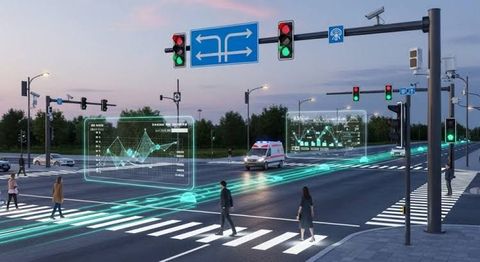
Learn About Smart Traffic Lights: Tips, Knowledge, and Helpful Resources
Smart traffic lights are electronically controlled traffic signals that use real-time information to manage the movement of vehicles, pedestrians, cyclists, and public transport at road intersections. Unlike conventional signals that may follow fixed timing schedules, smart traffic light systems can adjust signal phases according to traffic conditions.
These systems can combine cameras, radar, road sensors, connected devices, geographic information systems, and traffic-control software. The collected information helps a traffic controller determine whether a particular direction needs more or less green time.
The basic purpose is traffic flow management. When traffic volumes change throughout the day, adaptive traffic lights can respond to those changes instead of relying entirely on pre-programmed timings.
A typical intelligent traffic signal system can include:
Traffic cameras and vehicle detection systems
Radar, infrared, or other traffic sensors
Signal controllers
Central traffic management software
Communication networks
Pedestrian detection and crossing systems
Real-time traffic monitoring platforms
Emergency-vehicle priority mechanisms
Data analytics and AI-based traffic tools
The concept is part of the broader field of intelligent transportation systems (ITS), where information and communication technologies are used to improve transportation management.
How Smart Traffic Signal Technology Works
Smart traffic signals generally follow a continuous cycle of detection, analysis, decision-making, and signal adjustment.
Detection: Sensors or cameras identify traffic volume, vehicle presence, queues, pedestrians, and sometimes road incidents.
Analysis: Traffic management software processes the information and compares current conditions with traffic-control rules or optimization models.
Decision: The system determines whether signal timing should change. For example, a busy approach may receive additional green time while an empty approach receives less.
Control: The signal controller applies the approved timing changes.
Monitoring: Traffic monitoring systems continue collecting information to determine whether the adjustment is producing the intended result.
This creates real-time traffic signal control rather than relying only on fixed schedules.
Smart Traffic Lights vs. Conventional Signals
| Feature | Conventional Signals | Smart Traffic Lights |
|---|---|---|
| Timing | Often fixed or scheduled | Can adapt to conditions |
| Traffic detection | Limited | Sensors and cameras |
| Data use | Relatively low | Real-time data |
| Coordination | Often basic | Can coordinate multiple junctions |
| Congestion response | Limited | Dynamic |
| Pedestrian detection | May be manual | Can use automated detection |
| Emergency priority | Limited | Can support priority systems |
| Analytics | Limited | More extensive |
Smart systems do not necessarily eliminate fixed timing. In practice, fixed plans can remain important as fallback arrangements, while adaptive systems provide additional flexibility.
Why Smart Traffic Lights Matter Today
Traffic congestion is influenced by population growth, vehicle ownership, road design, construction, accidents, weather, events, and changing travel patterns. A signal plan that works well during one period may not work equally well during another.
Smart traffic management systems are intended to make better use of existing road infrastructure by responding to actual conditions.
They can be particularly relevant for:
Large urban intersections
High-traffic corridors
Areas surrounding schools and hospitals
Public transport corridors
Major commercial districts
Junctions with irregular traffic patterns
Smart city infrastructure projects
For road users, better signal coordination can make journeys more predictable. For traffic authorities, real-time information can help identify congestion and incidents more quickly.
Pedestrian smart signals can also support safer crossing arrangements by incorporating pedestrian requests or detection into signal operation.
AI, Sensors, and Connected Traffic Lights
Artificial intelligence is becoming an important part of modern traffic management. AI traffic lights can use computer vision and other analytical methods to interpret information from cameras and sensors.
For example, a camera-based system may identify vehicle queues, classify different road users, or detect unusual traffic conditions. AI-based analytics can then support traffic signal optimization.
Sensor-based traffic lights can use technologies such as:
Radar detection
Video detection
Infrared sensing
Inductive loop detection
Connected vehicle information
Pedestrian push buttons or detection devices
Connected traffic lights can also communicate with a central traffic management platform. This makes it possible to coordinate several intersections rather than treating every signal as an isolated location.
The broader objective is intelligent traffic management, where traffic signals, monitoring systems, enforcement technologies, road information displays, and transport data can work together.
Key Applications of Smart Traffic Technology
Smart traffic infrastructure has applications beyond ordinary intersection control.
Traffic congestion management: Adaptive signal timing can respond to changing queues and traffic volumes.
Emergency vehicle movement: Connected systems can support priority movement for ambulances and other emergency vehicles.
Pedestrian management: Signals can incorporate pedestrian requests and crossing information.
Public transport coordination: Signal timing can potentially be coordinated with buses and other scheduled transport services.
Incident response: Traffic monitoring systems can identify congestion caused by crashes, road closures, or other disruptions.
Corridor coordination: Several signals can be coordinated to create more consistent movement along major roads.
Data-driven planning: Historical traffic data can help authorities understand recurring congestion patterns and evaluate signal performance.
Important Factors in Traffic Signal Optimization
Smart traffic signal performance depends on more than installing sensors. The quality of the overall system matters.
Important considerations include:
Accurate vehicle and pedestrian detection
Reliable communication networks
Appropriate signal-control algorithms
Good-quality traffic data
Proper intersection design
Regular equipment maintenance
Cybersecurity protections
Clear fallback arrangements
Coordination between traffic agencies
Periodic performance evaluation
A technically advanced system can still perform poorly if sensors are incorrectly positioned, data is incomplete, or the traffic-control strategy does not match local road conditions.
Recent Developments in India
India has continued expanding intelligent transportation and advanced traffic-management technologies. In December 2025, the Ministry of Road Transport & Highways reported that Advanced Traffic Management Systems (ATMS) were being pursued on National Highways, including technologies such as AI-based video incident detection, Automatic Number Plate Recognition, surveillance cameras, and Variable Message Signs.
A major development came on 30 September 2026, when the Union Cabinet approved a ₹1,789.52 crore Intelligent Traffic Management System for Delhi. The project covers 42 identified traffic corridors and includes AI-enabled adaptive traffic signals, real-time traffic information, automated enforcement, and integrated command-and-control infrastructure.
The approved Delhi system includes 1,092 Adaptive Traffic Control System locations and 1,029 enforcement locations. It is planned in three phases over 24 months, followed by five years of operation and maintenance.
Hyderabad has also been part of this technology trend. In July 2026, the Telangana government reported discussions around developing an AI-powered traffic signal management system capable of responding dynamically to real-time traffic conditions.
These developments indicate a broader movement toward connected, data-driven traffic management in Indian cities.
Laws, Policies, and Government Programs in India
Smart traffic lights operate within India's wider road-transport and traffic-enforcement framework.
The Motor Vehicles Act, 1988, as amended, provides a legal basis for electronic monitoring and enforcement of road safety. Section 136A enables rules relating to electronic monitoring and enforcement, including technologies such as cameras and other specified devices.
Rules published in 2021 provide for electronic monitoring and enforcement at high-risk and high-density corridors, critical junctions in million-plus cities, and specified areas under the National Clean Air Programme. Technologies can include speed cameras, CCTV cameras, Automatic Number Plate Recognition, and other devices specified by governments.
The Rules of the Road Regulation, 2017 also establish requirements for following traffic control signals. Drivers approaching traffic signals must follow the relevant signal indications and stop appropriately when required.
At the national-road level, ATMS initiatives are being integrated with broader road-safety programs. Government information published in 2025 and 2026 highlights the use of incident detection, ANPR, surveillance, and real-time response technologies on National Highways.
Helpful Tools and Resources
People researching smart traffic lights can explore several types of resources:
Ministry of Road Transport & Highways: Policies, road-safety information, and intelligent transportation initiatives.
India Code: Central legislation and legal documents relating to motor vehicles and road transport.
Bureau of Police Research and Development: Material on technology-based and centrally controlled traffic signaling.
Traffic management dashboards: Useful for understanding congestion, incidents, and road conditions where publicly available.
GIS mapping tools: Helpful for studying intersections, road networks, and traffic corridors.
Traffic simulation software: Used in professional and academic environments to model signal timing and traffic flow.
Traffic-data platforms: Useful for analyzing vehicle movement and recurring congestion patterns.
Smart city project documentation: Helpful for learning how intelligent transportation systems are deployed at city level.
Research from IIT-linked technology initiatives also shows work on adaptive traffic signal controllers using GPS and sensors, including applications related to emergency-vehicle routing.
Frequently Asked Questions
What are smart traffic lights?
Smart traffic lights are traffic signals that use sensors, cameras, software, or connected data to adjust and coordinate signal operation according to traffic and road conditions.
How are adaptive traffic lights different from normal signals?
Traditional signals commonly use predetermined timing plans. Adaptive traffic lights can adjust timing based on detected traffic conditions, although fixed schedules may still be used as fallback or part of the control strategy.
Do smart traffic lights use AI?
Some systems use artificial intelligence or machine-learning techniques for vehicle detection, traffic analysis, incident identification, and signal optimization. However, not every adaptive signal system necessarily uses AI.
Can smart traffic signals help pedestrians?
Yes. Pedestrian smart signals can incorporate pedestrian requests, detection technology, crossing phases, and timing adjustments to support safer and more organized crossings.
Are smart traffic lights part of smart cities?
Yes. Smart traffic systems are commonly considered part of smart city infrastructure and intelligent transportation systems because they connect road infrastructure with sensors, communications, data platforms, and traffic-management tools.
Conclusion
Smart traffic lights represent a shift from primarily fixed signal timing toward more responsive and data-driven traffic control. By combining traffic sensors, cameras, connected systems, adaptive signal control, and analytics, intelligent traffic lights can respond more effectively to changing road conditions.
Their importance is increasing as cities manage growing traffic volumes while also focusing on road safety, pedestrian movement, emergency response, and efficient use of existing infrastructure.
In India, recent developments such as Delhi's 2026 Intelligent Traffic Management System and the continued expansion of Advanced Traffic Management Systems on National Highways show how smart traffic technology is becoming an increasingly important part of modern transportation planning.

Related Post...

Learn About Smart Home Hubs: Knowledge, Benefits, Setup Ideas, and Helpful Resources
Updated: November 22, 2026
Read More
Understanding Market Trend Interpretation Services: Tips, Knowledge, and Helpful Resource
Updated: November 23, 2026
Read More
Learn About Home Security Cameras: Tips, Knowledge, and Helpful Resources
Updated: November 23, 2026
Read More